Campground access control typically focuses on the main entrance gate — controlling who gets onto the property. But amenity access control — managing who can use specific facilities within the property — addresses a different set of operational challenges that are equally important for many parks.
The most common amenity access control applications at campgrounds are pool and aquatics facilities, laundry rooms, fitness centers, and in some cases game rooms or rental equipment areas. Each has specific drivers — safety compliance, fee collection, capacity management, or guest equity — that motivate the investment.
Pool Access Control
Swimming pools are the most frequent amenity access control application at campgrounds, and for good reason. Pools create legal liability that requires documented safety management, and in many jurisdictions require a lifeguard or impose restrictions on unaccompanied minor access.
Beyond safety compliance, pools at campgrounds face practical management challenges:
- Day-use visitors may use the pool without paying day-use fees
- Non-registered individuals may access the pool area during crowded periods
- Unaccompanied minors may be present without meeting minimum age requirements
- Capacity limits can be difficult to enforce without physical access control
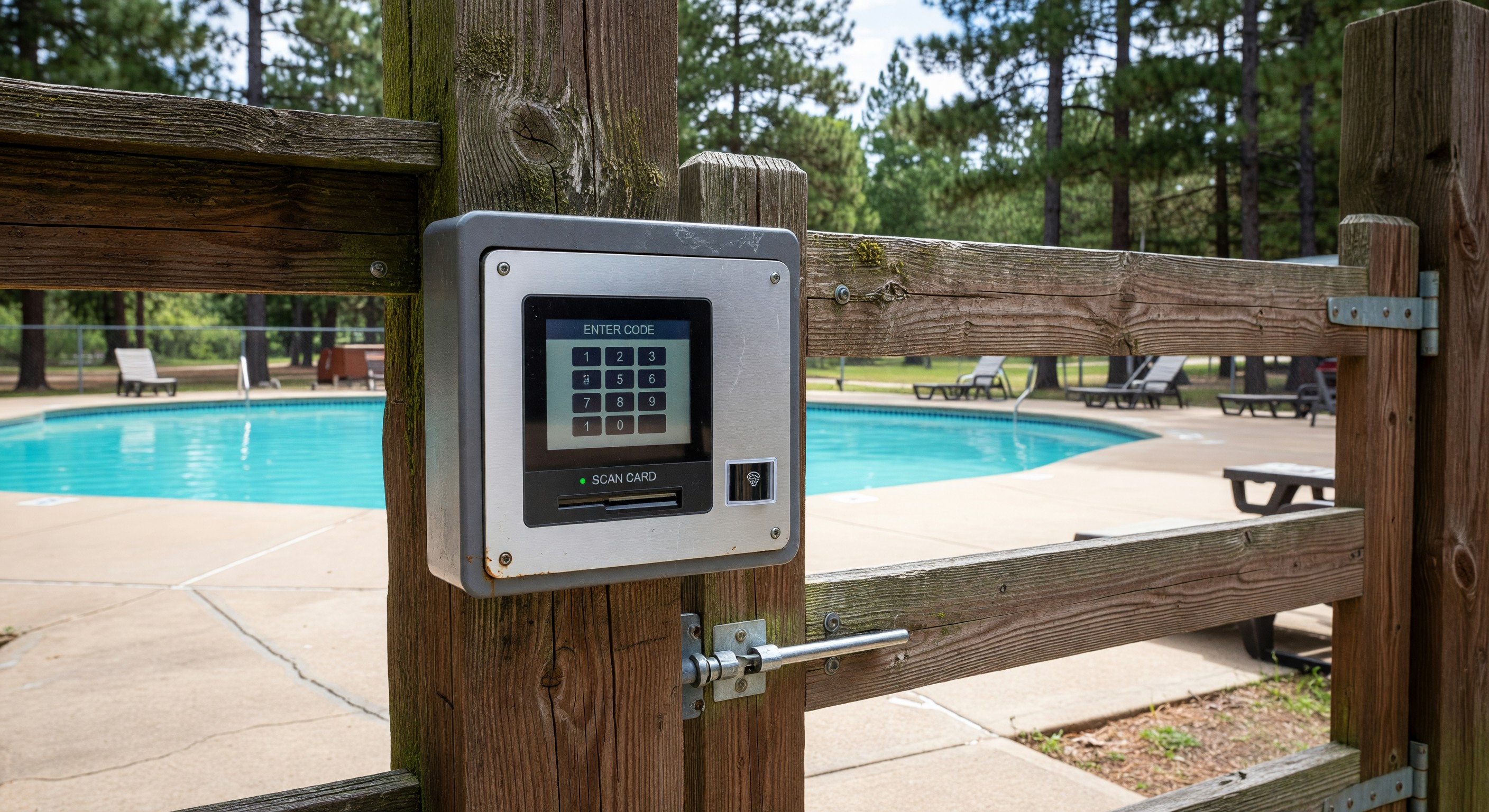
Electronic pool access control: Installing an access-controlled gate at the pool entrance — with credentials matched to current guest reservations — ensures only registered guests and authorized visitors can enter. The gate’s access log provides documentation of who used the facility and when, relevant to both liability management and capacity tracking.
Pool access control integrated with your reservation system can also enforce time-limited access passes for day-use guests who pay the appropriate fee, automatically denying re-entry after the pass expires.
Capacity management: Some campground pool gates integrate with occupancy counters — tracking entries and exits to maintain a current count of pool users. When capacity is reached, the gate displays a “Pool at capacity — please return later” message and denies entry until occupancy drops below the limit. This automated capacity management removes the need for staff to physically monitor pool occupancy.
Laundry Room Access Control
Laundry rooms at campgrounds are often accessible to the general public — unlocked and unmonitored. This creates problems in campgrounds near residential areas where non-guests use the facilities, reducing availability for paying guests and creating maintenance and security concerns.
Access-controlled laundry rooms — where entry requires a valid guest credential — ensure the facility serves paying guests. Combined with coin or card-operated machines, access control also protects the payment system from tampering by limiting access to registered guests only.
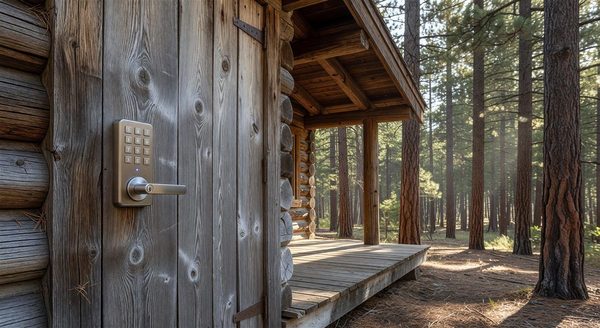
Laundry room access control doesn’t require elaborate systems. A simple RFID reader on the door, connected to the same credential database as the main gate, is sufficient. Guest credentials (the same code or card that opens the main gate) work for laundry room access as well.
Fitness Center and Recreation Room Access
Campgrounds upgrading to resort-level amenities are increasingly adding fitness centers, game rooms, and indoor recreation spaces. These premium facilities benefit from access control for the same reasons as pools: ensuring only registered guests and authorized visitors use the space and maintaining facility security during unstaffed hours.
Fitness centers raise additional concerns around equipment safety and liability — particularly for guests who may not understand proper equipment use. Some operators implement an orientation requirement before issuing fitness center access credentials, ensuring guests have basic safety awareness before using the facility independently.
Coordinating Amenity Access with Reservation Types
Not all campground reservations include access to all amenities. Amenity tiers are common at larger resort campgrounds:
- Standard sites: Main entrance access, pool access on weekends only, laundry access
- Premium sites: Full amenity access including fitness center, splash pad, recreation room
- Day-use passes: Time-limited access to pool and common areas, no laundry access
- Long-term residents: Full amenity access with monthly credential renewal
Access control systems that can enforce these distinctions — automatically granting the right combination of amenity access based on reservation type — remove the need for manual credential management and reduce frontline staff judgment calls about which guests qualify for which amenities.
Implementation Considerations
Credential consistency: Guests should use the same credential (code, card, or app) for all access points — main gate, pool, laundry, fitness center. Requiring different credentials or codes for each facility creates confusion and increases front desk support volume.
Offline operation: Amenity access points may have less reliable network connectivity than the main entrance. Confirm that the access control hardware can operate from locally-cached credential data during connectivity interruptions.
Emergency egress: Access-controlled amenity areas must maintain egress — guests inside must always be able to exit freely. Access control restricts entry; it must never trap people inside.
Maintenance and weather exposure: Pool area access hardware is exposed to pool chemicals and outdoor weather. Specify hardware designed for corrosive and outdoor environments — IP65 or IP68-rated readers for pool applications specifically.
Frequently Asked Questions
Is pool access control worth the investment for a small campground? For campgrounds with 50 or fewer sites and a small pool primarily used by a close-knit guest community, the administrative overhead may outweigh the benefits. For campgrounds with more than 100 sites, day-use programs, or pools near public areas, access control typically pays for itself through fee collection improvement and liability documentation.
Can guests share amenity access credentials with visitors? This is a policy question. Technology can support either approach: a credential that works for any bearer (allowing guests to share with visitors at their discretion) or a credential tied to an individual (requiring the credential holder to be present). For pool access where headcount matters for safety and capacity, individual credentials with verified occupancy counting are more appropriate.
What happens if a guest’s credential doesn’t work at the pool gate? A clear escalation path is important. Most guest credential failures are caused by the credential expiring (checkout time passed) or a system synchronization delay. A visible intercom or call button at the pool gate that connects to the front desk allows immediate resolution without the guest walking back to the office.
How does pool access control interact with lifeguard requirements? Access control manages who can enter the pool area; lifeguard requirements are separate safety regulations determined by your jurisdiction. If your pool requires a lifeguard when in use, access control can enforce closed periods (when the lifeguard isn’t present, the gate is locked) by scheduling access windows in the management platform. This automated enforcement is more reliable than manually locking and unlocking the pool gate around lifeguard schedules.
Further Reading from Authoritative Sources
- ARVC campground amenity management and operations standards — ARVC (National Association of RV Parks & Campgrounds) is the leading industry association for campground operators and publishes operations guidance including amenity management standards.
- NFPA life safety code requirements for access-controlled facilities — NFPA (National Fire Protection Association) publishes NFPA 101 Life Safety Code, which governs egress requirements in occupied facilities including recreational amenities.